AI Cover Letter Generator vs Writing From Scratch: Which Is Better?
Compare the speed of an AI draft with the control of writing from a blank page, then use a hybrid process that keeps your facts and voice at the center.

The short answer
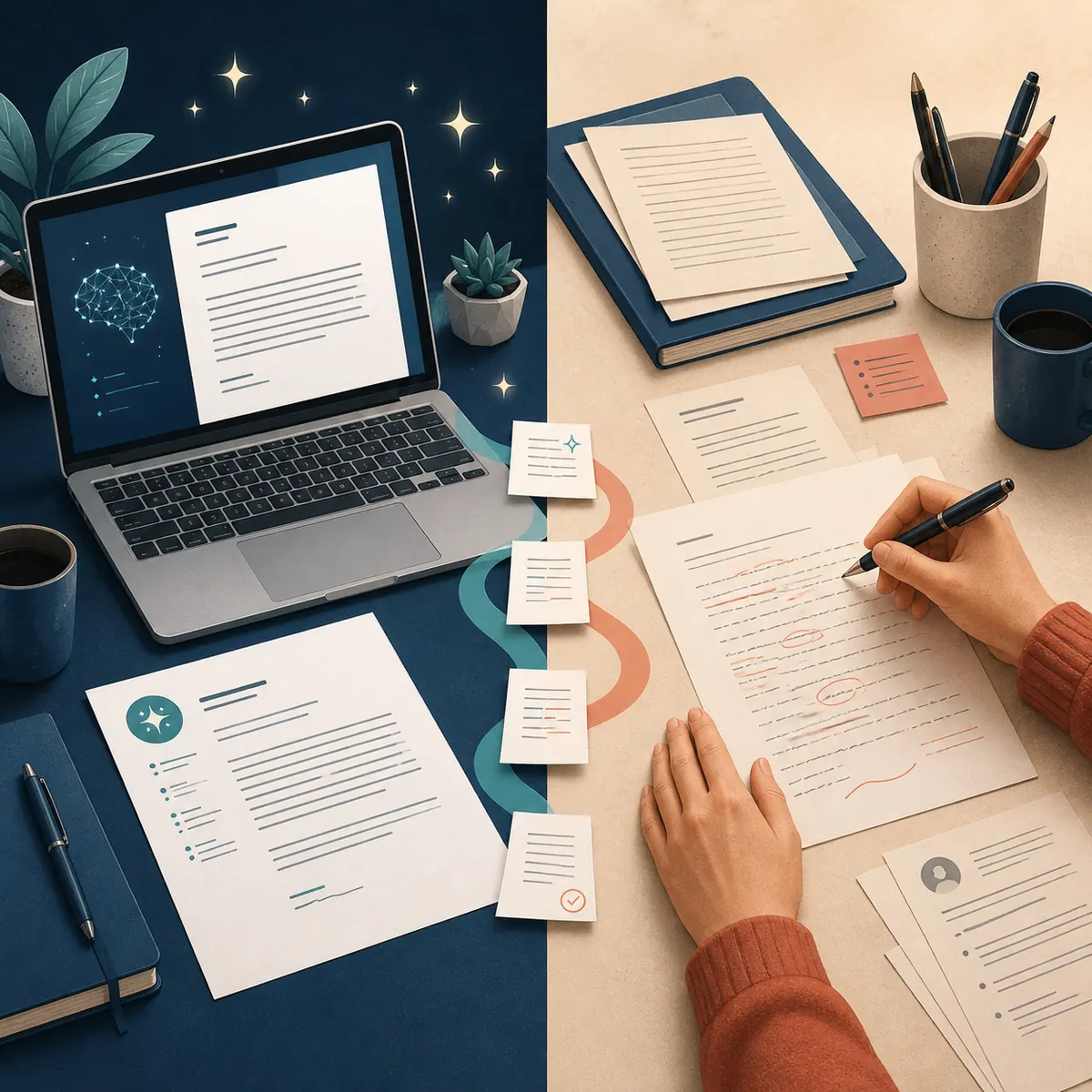
An AI cover letter generator is usually better when you have the facts but need a fast structure, a role-specific starting point, or a way to turn resume notes into a readable draft. Writing from scratch is better when the story is sensitive, highly personal, or so specific that generic wording would weaken it. For most applicants, the strongest option is a hybrid: you provide truthful evidence and a point of view, AI helps organize the first draft, and you rewrite the language until every claim is accurate and sounds like you.
Quick verdict: use AI for leverage, not authorship
The phrase AI cover letter generator can describe very different experiences: a blank-page writing assistant, a resume-based form, or a tool that matches a job description to your skills. None of those systems knows your career better than you do. The real question is where you want help: organizing information, finding a professional structure, or choosing the story that proves you fit the role.
If you already have a job description and a few truthful resume highlights, you can test the workflow with our free AI Cover Letter Generator and then use the comparison below to decide what to keep, rewrite, or remove.
- Choose AI first — when the main obstacle is time, structure, or turning scattered notes into a role-specific first draft.
- Choose a blank page first — when the letter depends on a personal transition, a difficult explanation, or a story that needs your exact voice from the first sentence.
- Choose the hybrid — when you want speed without surrendering ownership. Human facts and judgment should enter before and after the AI draft.
AI cover letter generator vs writing from scratch
A comparison is more useful when it measures the work involved rather than treating AI as automatically good or bad. The table shows the trade-offs most applicants feel during a real application.
| Decision point | AI generator | Writing from scratch |
|---|---|---|
| Starting time | Fast: a structured prompt can produce a first draft in minutes. | Slower: you must choose the angle, order, and wording yourself. |
| Structure | Helpful for a clear opening, evidence paragraphs, and close; still needs review. | Full control, but a blank page can make the first paragraph harder. |
| Personal voice | Can sound generic if the prompt contains no specific experience or samples. | Usually more natural at the start, especially for a personal story. |
| Job matching | Good at surfacing terms from the job description when you verify their fit. | Good when you already understand the role and can select evidence quickly. |
| Fact risk | May invent duties, tools, outcomes, or enthusiasm that you did not provide. | You control the facts, but rushed writing can still create mistakes. |
| Revision effort | Low for a rough draft, high if you accept generic copy without editing. | Higher up front, but fewer paragraphs may need a voice correction later. |
| Best use | A drafting partner, outline builder, or language editor. | A better first move for a distinctive, sensitive, or deeply personal application. |
When an AI cover letter generator is the better starting point
AI is most useful when the raw material is already yours and the bottleneck is shaping it. The tool should receive enough context to make a relevant draft, not a vague request for a perfect letter.
- You are applying to several related roles — A reusable set of verified achievements can be reorganized for different job descriptions without copying the same letter unchanged.
- You know your evidence but not the order — A generator can suggest a simple progression: why this role, which proof matters, and what you would contribute next.
- You need a language or clarity pass — A draft can help shorten long sentences, improve transitions, or make a professional tone consistent before you do the final rewrite.
- You want a second perspective — Ask the tool to identify unsupported claims, missing job-description terms, or paragraphs that do not show a clear result. Treat its feedback as a checklist, not a verdict.
When writing from scratch wins
Writing without a generator is not automatically more authentic, and using AI is not automatically less personal. A blank page is valuable when you need to make a careful human decision before any wording is polished.
- The story is sensitive — Career changes, layoffs, gaps, disability accommodations, or personal motivations may need a deliberate framing that a generic assistant cannot safely choose for you.
- Your strongest advantage is unusual — If your value comes from a specific project, community, portfolio, or non-linear path, write the core story yourself before asking for light editing.
- You have a strong natural voice — For senior, creative, mission-driven, or relationship-based roles, an original opening may be more persuasive than a polished template.
- You cannot verify the output quickly — If you are rushed or unfamiliar with the job's terminology, it may be safer to write only what you know than to accept confident but inaccurate suggestions.
A safer hybrid workflow: facts first, draft second, judgment last
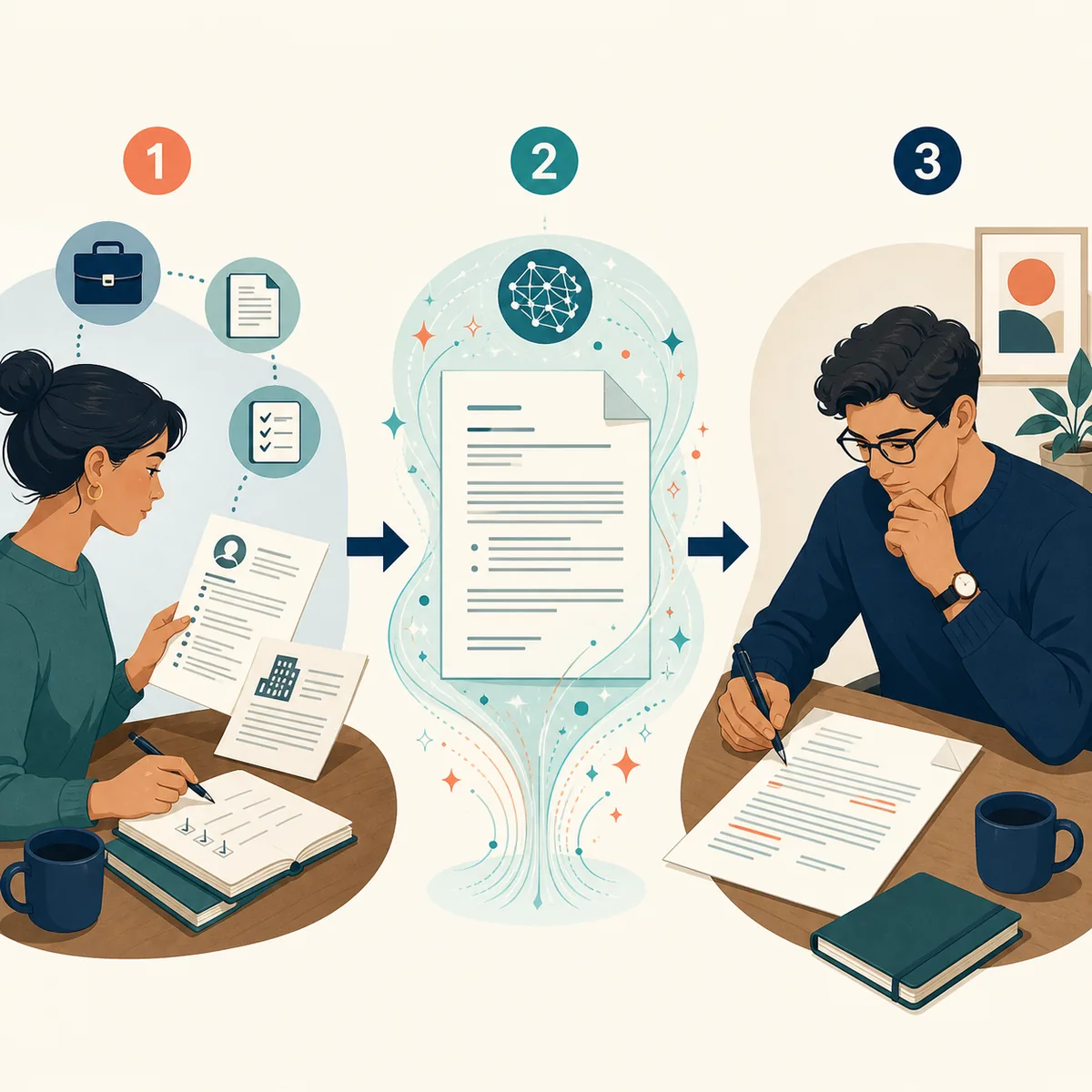
The best middle ground is not to hide that AI helped. It is to make the human checkpoints visible in your process. Start with a small evidence bank, then use AI for organization and editing rather than invention.
- 1. Collect the evidence
Write down the target job, the employer's actual needs, two or three measurable results, the tools you used, and one example of how you solved a relevant problem.
- 2. Set the boundaries
Tell the generator not to invent employers, titles, dates, metrics, software, awards, or responsibilities. Ask it to mark missing information instead of guessing.
- 3. Request a focused draft
Ask for a concise letter with one reason for interest, two evidence-based connections to the role, and a clear close. Avoid asking for an exaggerated or perfect letter.
- 4. Rewrite the proof
Replace broad phrases with your own details. If a sentence could describe any applicant, add the action, context, constraint, or result that makes it yours.
- 5. Review against the job description
Check names, keywords, dates, tone, length, and claims line by line. Read it aloud once; awkward wording and inflated enthusiasm become easier to spot.
For a more detailed prompt and step-by-step example, read How to Write a Cover Letter with AI .
How to make an AI-generated cover letter sound like you
The final edit is not a cosmetic step. It is where you decide whether the letter represents a real person with a credible reason for applying. A useful draft should become more specific as you revise it, not merely more enthusiastic.
- Keep one real detail per paragraph — Mention a project, customer problem, process improvement, research question, or result that you can explain in an interview.
- Delete borrowed enthusiasm — Phrases such as passionate, thrilled, and perfect fit are weak unless the next sentence proves why they are true for this role.
- Use the language you actually speak — A hiring manager should hear a clear professional voice, not a stack of grand claims that you would never say aloud.
- Match the requested format — Keep the greeting, paragraphs, closing, and length appropriate for the application. Do not add a keyword block or a second resume in letter form.
- Read the complete letter beside the resume — The two documents should reinforce each other without repeating every bullet. Use the letter to explain relevance and the resume to show the broader record.
Use the cover letter format guide to check the layout after the wording feels accurate.
Risks to check before you send an AI-assisted letter
Searchers often ask whether companies check cover letters for AI or whether AI-generated cover letters work. There is no universal detector or universal employer policy you can rely on, so focus on the quality and truthfulness of the document you control.
- Invented facts — Remove any achievement, metric, company detail, technology, or responsibility that you cannot verify from your own experience.
- Generic fit language — If the letter could be pasted into ten applications without changing a noun, it needs a more specific connection to the role.
- Over-optimized keywords — Use the employer's terminology only when it accurately describes your skills. Repeating keywords can make the letter harder to read.
- Privacy assumptions — Do not paste confidential client information, private contact details, or sensitive employer material into a service unless you understand its data practices.
- No final human read — You are responsible for the final names, dates, claims, tone, and attachment choice, even when a tool helped create the first draft.
FAQ
Further reading
Ready to compare the two approaches on your next application?
Start with the job description and your real resume highlights, generate a focused draft, and keep the final decision in your hands.
Open the AI Cover Letter Generator