How to Address an Envelope Correctly: Format & Examples
Place each address in the right area, write every line in postal order, and handle apartments, PO Boxes, businesses, families, and international mail without guesswork.

Quick answer
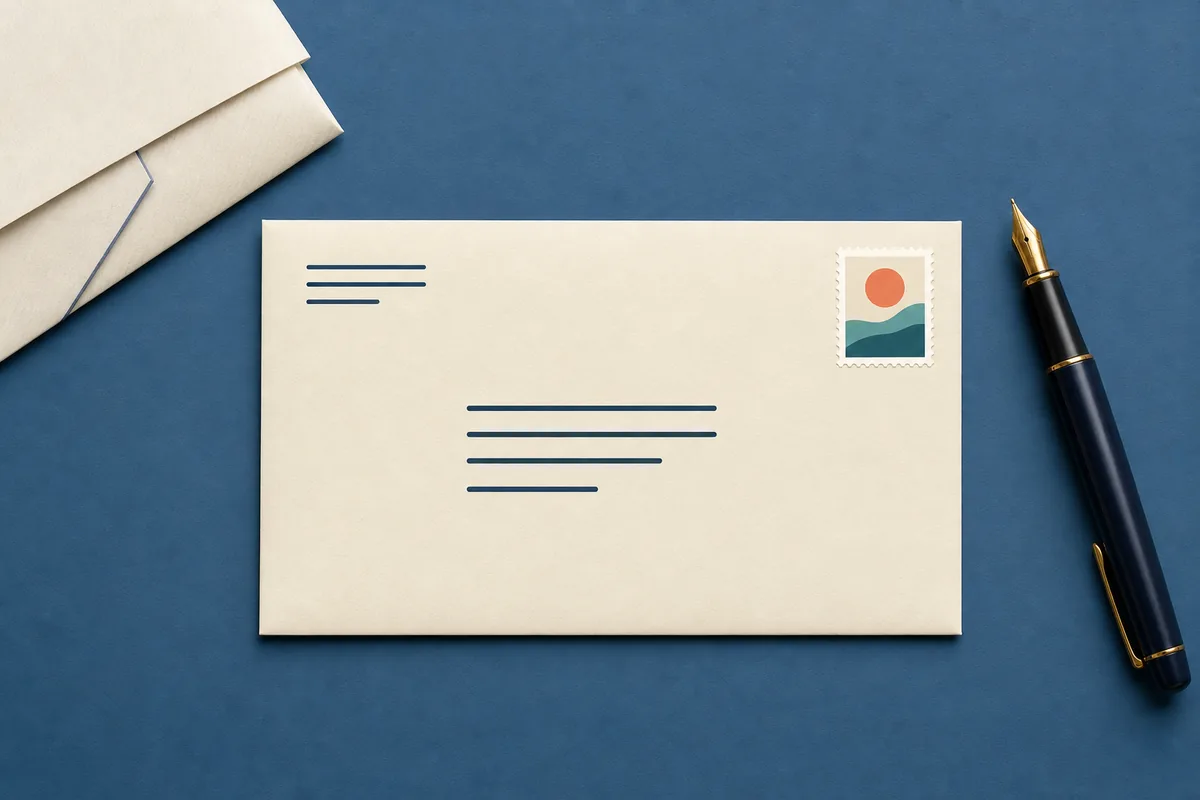
To address an envelope, write the recipient’s full name and postal address in a clear block in the center. Put the return address in the upper-left area or the postal service’s recommended position, and place postage where required. For horizontal envelope writing, keep the address lines aligned and follow the destination country’s order for street, region, postal code, and country.
Where to Write the Address on an Envelope
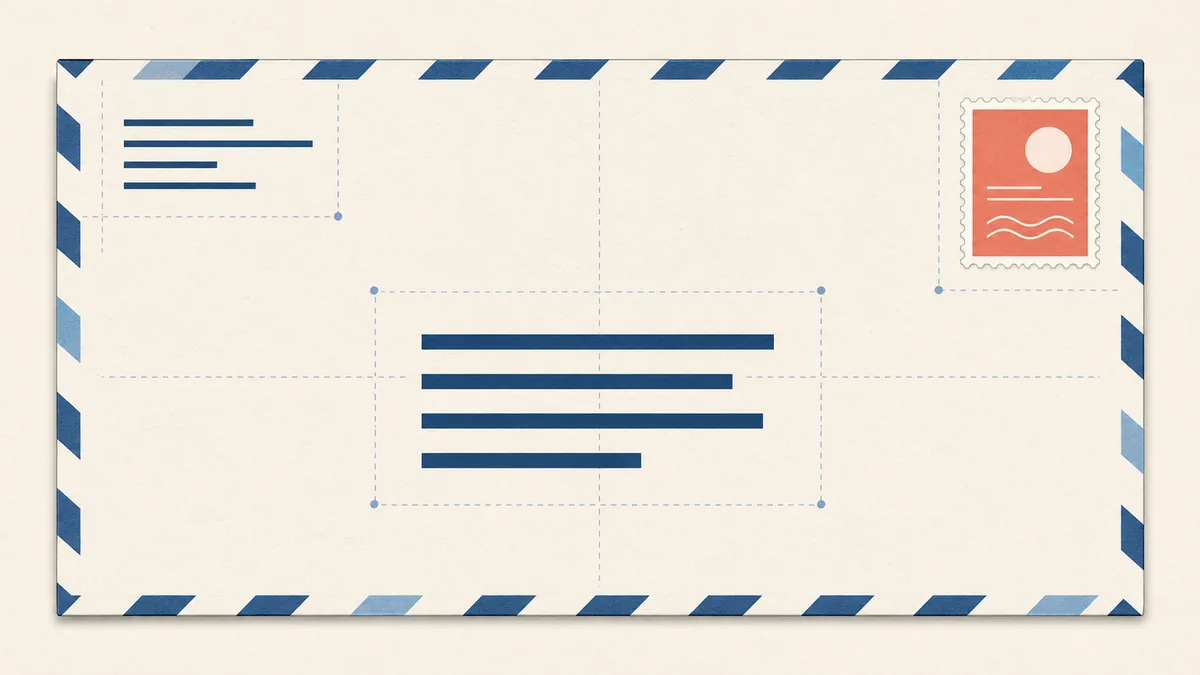
A machine-readable envelope has three visually separate zones. Keeping those zones clear is more important than making the front look decorative. Leave enough white space around the destination address so a postal worker or sorting system can recognize it immediately. If the envelope already has a printed window, use a letter layout that places the recipient address fully inside that window rather than writing a second destination on the outside.
Upper left
Write the sender's return address here. It tells the postal service where to return undeliverable mail and helps the recipient identify the sender before opening the envelope.
Center
Place the recipient's complete delivery address in the clearest, largest block. Center it horizontally and keep it below the visual midpoint when possible.
Upper right
Attach the correct stamp or postage mark here. Keep it away from both address blocks and do not cover it with tape or decoration.
Letter Address Format: What Goes on Each Line
The exact order can vary by country, but the destination block should move from the most specific person or organization to the broader delivery location. Use the recipient's official name and the postal spelling of the street, city, region, and postal code. When an organization publishes a preferred mailing address, copy it rather than rewriting or abbreviating it from memory.
| Line | What to include | Example |
|---|---|---|
| 1 | Recipient's full name or responsible department | Jordan Lee |
| 2 | Company, school, agency, or organization when relevant | Northwind Design Studio |
| 3 | Street number and street name, or the verified PO Box | 1458 Cedar Avenue |
| 4 | Apartment, suite, unit, floor, building, or mail-stop detail | Apt 4B |
| 5 | City, state or region, and postal code in local postal order | Portland, OR 97205 |
| 6 | Country name in capital letters for international mail | UNITED STATES |
For domestic mail, omit the country line unless the local postal authority asks for it. For international mail, write the destination country clearly in the language accepted by the sending postal service. Do not mix a street address and PO Box unless the recipient or postal operator specifically provides a combined format.
How to Address an Envelope Step by Step
Before writing on the envelope, verify the address from a reliable source: the recipient, an official directory, an invoice, a school or company website, or a postal address checker. Guessing one missing digit can send an otherwise perfect letter to the wrong delivery route.
- Choose an envelope that fits
Use an envelope large enough for the letter to lie flat or fold neatly. Avoid bulges, loose objects, or edges that prevent the envelope from sealing. If you are mailing documents that should not be folded, use a document envelope and follow the same placement principles at the larger scale.
- Write the recipient name
Use the person's complete preferred name. Add a professional title only when it is known, relevant, and current. For departments or teams, use a specific functional name such as Accounts Payable, Admissions Office, or Customer Support instead of an uncertain personal name.
- Add the delivery lines
Copy the street number, street name, unit, city, region, and postal code exactly. Keep unit information on the same line as the street when space and local practice allow; otherwise put it immediately below. Do not place explanatory notes inside the address block.
- Add the return address
Write your name and deliverable mailing address in the upper-left corner. The return address should be smaller than the recipient block but still readable. If privacy is a concern, use an authorized business address or PO Box rather than omitting a return path from important mail.
- Apply postage and check spacing
Place the correct postage in the upper-right corner. Confirm that nothing overlaps the addresses, the envelope is sealed, and the writing contrasts with the envelope color. Ask the postal counter to weigh unusual, rigid, thick, international, or oversized mail.
- Read every line once more
Compare the finished envelope with the verified source. Check names, unit numbers, directionals such as North or SW, postal codes, country names, and the sender address. A ten-second comparison prevents most avoidable addressing errors.
How to Address Apartments, PO Boxes, Businesses, and Other Cases
Special addresses are not difficult when each delivery qualifier stays close to the line it modifies. The examples below use generic information; replace every detail with the exact format supplied by the recipient or postal authority.
Apartment, suite, or unit
Put the apartment or unit immediately after the street address or on the next line. Never drop it because the building has a front desk; the unit is often essential for final delivery. Common labels include Apt, Unit, Suite, Floor, or a locally accepted equivalent.
Maya Chen
88 Market Street, Apt 12C
San Francisco, CA 94105
PO Box
Use the verified PO Box as the delivery line. Do not replace it with the physical street address unless the recipient gives that address for the specific carrier. Include the city, region, and postal code associated with the box, which may differ from a nearby street address.
River Community Fund
PO Box 417
Austin, TX 78767
A person at a business
Put the person's name first, the company or department second, and the delivery address next. This order helps both the postal carrier and the organization's internal mailroom. Add an attention line only when the organization asks for one.
Taylor Morgan
Attn: Vendor Relations
Bright Field Services
2400 Lake Road, Suite 300
Chicago, IL 60601
A family or couple
For personal mail, use the names the recipients use themselves. A neutral form such as 'Alex Rivera and Sam Lee' is accurate without assuming titles or a shared surname. For an entire household, 'The Rivera Family' is acceptable when that is how the household identifies.
Alex Rivera and Sam Lee
72 Willow Lane
Madison, WI 53703
International mail
Follow the destination country's line order, write the destination country in capitals on the final line, and keep that country line by itself. Some countries place postal code before the city; others use province, prefecture, county, district, or building information in a different sequence. Verify the current format with the destination postal operator before mailing valuables or time-sensitive documents.
RECIPIENT NAME
LOCAL STREET AND BUILDING FORMAT
POSTAL CODE CITY OR REGION
DESTINATION COUNTRY
Complete Envelope Address Examples
These examples show how the lines work together, including a horizontal address layout. The names and addresses are fictional: keep the recipient block prominent, separate the return address, and follow local postal order.
Personal letter and horizontal address
Recipient / recipient address:
Morgan Patel
153 Garden View Drive
Denver, CO 80206
Return address:
Casey Brown
41 Oak Terrace
Boulder, CO 80302
Business letter
Recipient:
Riley Brooks
Procurement Department
Summit Office Supply
900 West Avenue, Suite 210
Boston, MA 02110
Return address:
Jamie Wilson
Crescent Studio
18 Pine Street
Providence, RI 02903
PO Box delivery
Recipient:
Community Arts Council
PO Box 802
Santa Fe, NM 87504
Return address:
Avery Kim
56 Juniper Road
Albuquerque, NM 87106
International letter
Recipient:
RECIPIENT NAME
STREET / BUILDING / UNIT
LOCAL POSTAL CODE AND CITY
DESTINATION COUNTRY
Return address:
SENDER NAME
FULL RETURN ADDRESS
SENDER COUNTRY
Common Envelope Addressing Mistakes
Most delivery problems come from incomplete information, ambiguous placement, or a format copied from an outdated source. Review these issues before sealing the envelope.
- Missing apartment or suite — A correct building address may still be undeliverable when the final unit is absent.
- Swapping sender and recipient — The main destination belongs in the center; the return address belongs in the upper left.
- Using a nickname or guessed title — Use the recipient's verified preferred name and avoid assumptions about honorifics, marital status, or job role.
- Mixing old and new address details — Do not combine a former street, a new postal code, and a company name from different sources.
- Writing too close to the edge — Leave clear margins so sealing, handling, barcodes, and postal marks do not cover the address.
- Decorating the address zone — Stickers, dark patterns, glossy tape, and handwriting across the destination block can reduce readability.
- Assuming every country uses the same order — International address components and line order vary; confirm the destination operator's current guidance.
- Forgetting a final verification — Compare the envelope with the original address instead of trusting memory or an old contact entry.
Address the Envelope, Then Review the Letter Inside
Once the outside is correct, use our step-by-step letter writing guide to check the greeting, purpose, body, closing, and signature. If you still need a first draft, open the free AI Letter Writer and describe the recipient, purpose, tone, and facts you want included.
Before mailing, confirm that the name on the envelope matches the greeting inside, every attachment mentioned is enclosed, sensitive information is necessary, and the postage suits the size and destination. Keep a copy or tracking record when the letter has legal, financial, employment, school, or deadline consequences.
Frequently Asked Questions
Official addressing references
Need help writing the letter inside?
Generate a focused first draft, then personalize the facts, tone, greeting, and closing before you print and mail it.
Open the Free AI Letter Writer