How to Write a Formal Email: Format, Examples & Tips
A practical guide to writing clear, professional emails for work, school, customer service, and official requests.

Quick answer
To write a formal email, use a specific subject line, a respectful greeting, a first sentence that states the purpose, short paragraphs with relevant facts, a clear request, and a professional sign-off. Check names, dates, links, attachments, and privacy before sending.
Plan a formal email before you draft it
A short plan prevents a formal email from becoming vague or overloaded. Decide what the reader needs to know and what you want them to do next.
- Name the purpose
Write the reason for contacting this person in one sentence: request, update, inquiry, complaint, follow-up, or confirmation.
- Identify the reader
Check the recipient's name, role, organization, and preferred contact details. Use a verified team or role when a personal name is unavailable.
- Choose the requested next step
Decide whether you need an answer, approval, document, appointment, correction, or confirmation, and say so plainly.
- Collect facts and attachments
Prepare only the dates, reference numbers, links, files, and background details the reader needs to act.
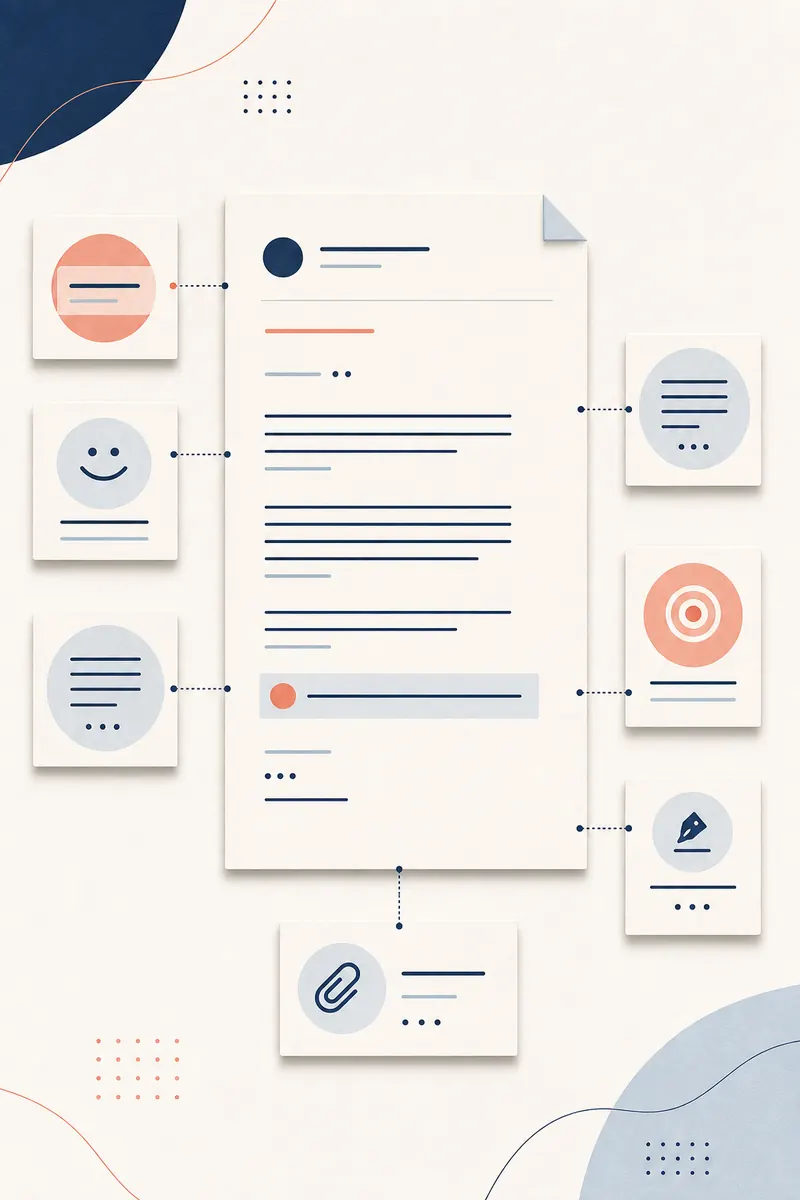
Formal email format: 7 parts
The exact layout varies by situation, but these seven parts give most professional emails a predictable path from purpose to action.
| Part | Include | Purpose |
|---|---|---|
| Subject line | Specific topic and, when useful, a date or reference | Helps the reader understand priority and context before opening |
| Greeting | Name, role, or verified team | Shows respect without guessing a title or spelling |
| Opening | The reason for writing in the first sentence | Lets a busy reader understand the request quickly |
| Context | Only the facts needed to understand the situation | Supports the request without burying it in history |
| Request | One clear action, response, or deadline | Makes the next step easy to identify |
| Closing and sign-off | A courteous final sentence and suitable sign-off | Ends the message with the right level of formality |
| Signature and attachments | Name, role, contact path, and named files | Gives the reader a way to respond and verify the materials |
How to start a formal email
The opening should be respectful and useful. Skip a long warm-up and make the reason for writing visible early.
When you know the recipient's name
Use the recipient's preferred title and surname when you have verified them. If the relationship is established and the recipient uses a first name, follow the tone already used in the conversation.
- Dear Ms. Patel, I am writing to request an updated copy of the service agreement.
- Hello Dr. Chen, I am following up on the appointment options you shared last week.
- Dear Jordan Lee, Thank you for reviewing the attached proposal.
When you do not know the name
Address the verified role, department, or team rather than guessing a name. A precise role-based greeting is usually more useful than a generic phrase.
- Dear Hiring Manager, I am writing to ask about the status of my application.
- Dear Customer Support Team, I need help correcting the invoice attached to this email.
- Dear Admissions Committee, I am submitting the requested document for review.
Write a concise body with a clear request
A formal email should be easy to scan. Keep each paragraph focused and make the requested action visible instead of expecting the reader to infer it.
Give the essential context
State what happened, what you are referring to, or why the message is timely. Include a date, account reference, or earlier conversation only when it helps the reader locate the issue.
Make one main request
Use a direct sentence such as 'Could you confirm the revised delivery date?' If there are several tasks, number them so the recipient can answer each one.
Explain the next step
If a deadline or reply format matters, say so politely. For example, ask for confirmation by a date or explain which option you prefer.
A body paragraph is usually ready when it answers:
- What is the situation or reference point?
- What do I need the recipient to do?
- What facts or files support the request?
- What should happen next, and when?
How to end a formal email
The closing should match the relationship and the purpose. Thank the reader when appropriate, state the next step, then use a sign-off that fits the level of formality.
| Tone | Closing | When to use |
|---|---|---|
| Standard professional | Thank you for your time and consideration. / Best regards, | Most workplace, school, and service messages |
| Formal request | I would appreciate your confirmation. / Sincerely, | Official requests or a first contact |
| Helpful follow-up | Please let me know if you need anything else. / Kind regards, | Ongoing conversations and coordination |
| Action-focused | I look forward to your reply. / Regards, | When a clear response is expected |
Formal email examples
Use these examples as structures, not scripts. Replace the placeholders with verified facts and remove any sentence that does not help the reader respond.
Example 1: a clear service request
Subject: Request for corrected invoice — Account 458219
Dear Customer Support Team,
I am writing about the invoice issued on August 6 for account 458219. The installation fee appears twice, although the service agreement lists it once.
Could you review the charge and send a corrected invoice? I have attached the invoice and the relevant agreement for reference.
Thank you for your help. I would appreciate confirmation after the correction is made.
Best regards,
Alex Johnson
Example 2: a professional follow-up
Subject: Follow-up on proposal review
Hello Jordan,
I am following up on the proposal I sent on August 4. I know your team may need time to review the details.
Could you let me know whether the timeline is still suitable, or whether you would prefer a short call to discuss the next step?
Please tell me if you need any additional information.
Kind regards,
Morgan Lee
Review a formal email before sending
A final review protects both clarity and trust. Read the message once as the recipient: can they identify the purpose, action, deadline, and supporting material without guessing?
- Check the recipient's name, role, organization, dates, amounts, links, and reference numbers.
- Make sure the subject line matches the actual request and does not overstate urgency.
- Confirm that every promised attachment is present, named clearly, and safe to share.
- Remove unnecessary private information, emotional wording, and claims you cannot support.
- Read the message aloud once to catch abrupt transitions, ambiguity, or an accidental informal phrase.
If you want help turning your facts into a draft, you can use the AI Formal Letter Generator, then verify every detail before sending.
Common formal email mistakes
- A vague subject line — Replace 'Question' with a subject that names the topic, action, or reference.
- The purpose appears too late — State why you are writing in the opening instead of making the reader search for it.
- Too many requests in one paragraph — Separate multiple actions into numbered points or a short list.
- An unsupported promise or claim — Use only facts you can verify and avoid inventing policy, legal, or financial conclusions.
- The attachment is missing — Check the files and mention each important attachment by name before sending.
Formal email FAQ
Further reading
Need a formal letter instead?
For a formal letter with a structured draft, use the dedicated generator and review the result before sending.
Open the AI Formal Letter Generator